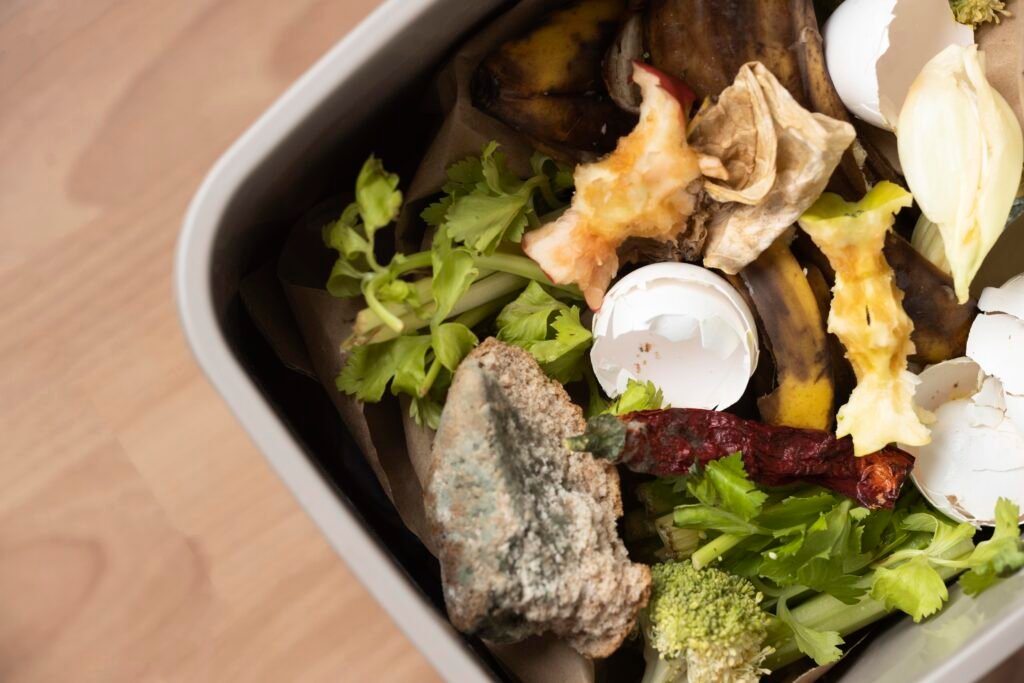
Before living in London, I always separated my food waste. Recycling, compost and landfill were the categories growing up. We lived on a farm, so veggie peels would first go in a bucket for the chickens to scratch through and then into the composter – a big box behind the shed.
Every place I’ve lived since has had a council food waste bin provided. Shortly after arriving in “the big city”, I found myself digging through the new flat, looking for where my housemates stored the scraps. No dice. Writing to the council revealed that they simply didn’t offer food waste collection from apartment buildings. Now, things are finally changing.
England’s updated food waste system
Across England, councils are being required to introduce weekly food waste collections for households, including flats and communal properties, under the Government’s “Simpler Recycling” reforms. The new rules mean food waste must be collected separately from general rubbish and recycling, helping reduce landfill emissions and improve recycling rates. According to the Department for Environment, Food and Rural Affairs (Defra), these requirements apply to all households. All those little bins are going to make up a huge difference, so this feels like a win for the environment and the country. In London, it was due to start in August and was delayed – but honestly, it feels like this is years’ overdue. Why are some buildings only able to get bins now?
In general, London was slow to adopt a food waste system due to a combination of high-density housing, restrictive legacy waste contracts and funding disagreements. It took the government a while to put a plan in place, and let’s be real, even longer to prioritise the issue. But, hey, at least we’re here now!
While the new recycling rules officially came into force in England in March 2026, a roll-out delay occurred as many councils have been granted transitional arrangements. This was because implementing entirely new collection systems is expensive and complicated. Councils have needed new vehicles, new contracts, new bin storage solutions and entirely new collection routes. Some local authorities have also cited long-term waste contracts and funding challenges as reasons for delays. They are particularly struggling to service densely populated urban areas, where apartment blocks present unique storage and collection issues. The result is that some Londoners already have food waste bins, while others are still waiting. Unlike previous attempts, however, this roll-out is backed by national legislation, meaning separate food waste collection is no longer simply a nice idea, it’s the new standard. So if you don’t have a bin yet, it shouldn’t be long.
What happens to your food waste?
Most separately collected food waste in England is sent to anaerobic digestion facilities. Anaerobic digestion is a process where microorganisms break down organic material in an oxygen-free environment. The food waste produces bio-gas, which can be used to generate renewable electricity, heat and biomethane fuel. The remaining material (known as digestate) can be used as farmland fertiliser. More happy chickens!
The collection process is surprisingly quick. Under the new system, your food waste is usually picked up weekly, transported to a processing facility, sorted to remove contamination and then fed into sealed digestion tanks. Depending on the facility and processing method, the digestion process can take several weeks before the resulting gas and fertiliser products are ready for use.
This process matters because food waste behaves very differently depending on where it ends up. When it decomposes in landfill, it generates methane, a greenhouse gas significantly more powerful than carbon dioxide over a 20-year period. The Intergovernmental Panel on Climate Change (IPCC) identifies methane as a major contributor to global warming. By collecting food waste separately and sending it for anaerobic digestion, councils can reduce emissions while also generating renewable energy. Isn’t it cool? Our potato peelings might help power homes or fertilise crops. Not bad for something that was heading for the landfill.
The pros and cons of food waste collections
Pros
Food waste collections have plenty of advantages, with a major benefit being environmental. WRAP estimates that food waste makes up a significant proportion of household residual waste in the UK. Diverting this waste away from landfill reduces greenhouse gas emissions and allows valuable nutrients to be recovered through fertiliser production. Another benefit is energy generation. Anaerobic digestion plants produce renewable energy that can be fed into electricity grids or converted into biomethane. Food waste collections can also improve recycling quality overall. When food scraps are removed from general rubbish, contamination rates often fall, making other recycling streams easier to process.
There is also a social benefit that often gets overlooked. For children and families, food waste collections can become an easy introduction to environmental awareness. Like I did, city kids can now quickly learn which foods can be recycled, where waste goes and why reducing it matters. Research published by the United Nations Environment Programme highlights the importance of environmental education and household participation in reducing food waste.
Cons
Of course, the system isn’t perfect and there are challenges too. Introducing new collection services costs money. As mentioned earlier, councils need specialised vehicles, additional staff, processing contracts and public education campaigns. Apartment buildings can also face storage issues. Finding room for communal food waste bins in already crowded bin stores is not always easy.
Then there is the social concern that most people secretly have: smell. Nobody wants a kitchen that smells like a forgotten banana peel. Fortunately, councils that have already run successful food waste schemes have found that weekly collections, sealed caddies and proper liners significantly reduce odour and pest issues. London councils are building from that existing template, but now they just need to convince the new users to actually follow through. When my building was issued the small, free food waste bins, I was sad to see several of them dumped in the car park recycling skip that same day. Like most recycling systems, success depends on participation. The more people that use the service correctly, the more effective and efficient it becomes. Let’s just hope those of us using them outweigh those who aren’t, encouraging our councils to continue and justifying the cost.
Food waste collections around the world
The UK is actually catching up rather than leading the way. There are plenty of cities around the world where food waste has been successfully collected, despite facing similar urban challenges as our government. I was curious to see how our new programme stacks up.
Seoul
One of the most famous programmes is in Seoul in South Korea. The city introduced a sophisticated food waste recycling system that uses smart bins, weight-based charging and advanced processing technologies. Seoul now recycles the vast majority of its food waste rather than sending it to landfill.
Milan
Milan in Italy has a food waste collection that is considered one of the most successful urban recycling programmes in Europe. The city achieved high participation rates by providing clear guidance, regular collections and easy-to-use kitchen caddies. Research published by Zero Waste Europe identified Milan as a leading example of urban food waste management.
San Francisco
In the US, San Francisco has been lauded for its composting and organic waste programmes. The city requires compostable waste separation and has invested heavily in public education, even offering some financial incentives for participants. Mandatory composting was introduced in 2009 and requires both residents and businesses to participate in waste sorting.
Meanwhile, some major cities still have limited or inconsistent food waste collection systems. In parts of the United States, Australia and rapidly growing cities across the Global South, food waste often continues to be sent directly to landfill. This occurs despite growing evidence that separate collection systems reduce emissions and improve resource recovery. The lesson from all these places is clear. Food waste collection works best when it becomes part of everyday life rather than something people have to actively remember. The easier the system is, the more people use it.
How to get and use a food waste bin in London
Most London boroughs provide information through their council websites, where residents can request food waste caddies, replacement bins or collection services. Under England’s new recycling requirements, food waste collections must be provided free of charge for all households.
If you live in a standalone house, you may already be eligible for a food waste collection service. If you live in a flat, the process can be a little more complicated because communal bin arrangements often involve managing agents, landlords, housing associations and councils working together. If your building does not currently offer food waste recycling, it is worth contacting both your local council and building management company. Many boroughs are still rolling out services building by building.
Once you get a food waste caddy, keeping it clean is easier than most people expect. Lining the caddy with newspaper or approved liners can help keep things tidy. Keeping the lid closed reduces smells and discourages insects – essential in this heatwave! If you have freezer space, storing particularly smelly food scraps (such as meat bones) in a small freezer container until collection day can also help. Emptying the caddy regularly, even when it is not completely full, makes a huge difference. A five-minute habit once a week is usually enough to avoid any unpleasant surprises.
Most importantly, remember that food waste bins are designed for scraps, not pet manure or sanitary items. Vegetable peelings, eggshells, tea bags, coffee grounds, bones, leftovers and spoiled food can generally be included, although residents should always follow their local council guidance.
Embracing change
For years, food waste recycling in London felt like something that worked everywhere except apartment buildings. Now, it is finally becoming an option for more Londoners, including those of us living in council flats. It might seem like a menial daily change, but the benefits are significant. Cities are one step closer to a circular economy where waste becomes a resource rather than a problem.
The roll-out may not be perfect and some boroughs are still catching up, but progress is happening. If your building gets a food waste bin this year, please try and use it. If your council offers the service already, why not sign up? If your block does not have one yet, keep asking. Sometimes real environmental change can start with something as small as a potato peel.