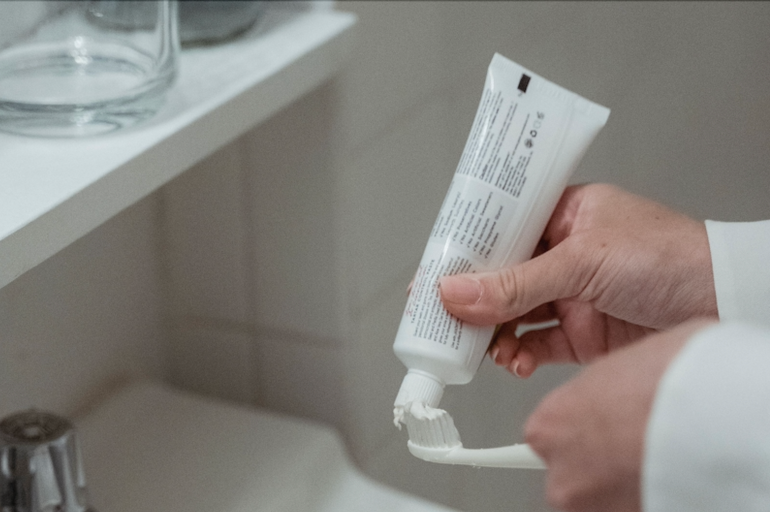
A friend recently noted that toothpaste packaging feels more plastic-y than it used to. Turns out, she was right – but it’s actually good news! I got curious as to why, and which brands are making environmentally friendly moves.
Along the way, I’ve learned toothpaste packaging has changed dramatically over the last 150 years – with each new material seemingly solving one problem and creating another. It’s a great example of how sustainability isn’t always as straightforward as swapping plastic for something else. Sometimes the greener option isn’t the best material, but the one that works best within existing recycling systems. Here’s a quick history…
A timeline of the toothpaste tube
Pre-1892: powders and glass jars
Toothpaste was invented in several stages, beginning with ancient tooth powders around 5000 BC by the Egyptians, followed by Dr. Peabody adding soap to a dental paste in 1824, and Colgate mass-producing the first commercial paste in 1873. People generally bought tooth powders or homemade pastes stored in ceramic pots, glass jars or small tins. Victorian households often dipped a toothbrush directly into the container (feels rather unhygienic today!).
Glass had one environmental advantage—it could be reused or recycled—but it was heavy, fragile and expensive to transport. Manufacturers also found that repeatedly opening jars exposed toothpaste to air and bacteria, shortening its shelf life. Brands such as Colgate eventually adopted tubes.
1892: the toothpaste tube invented
American dentist Dr Washington Sheffield introduced toothpaste in a collapsible metal tube. Inspired by artists’ paint tubes used by his son, he realised toothpaste could be stored far more hygienically and conveniently. His company, Sheffield Dentifrice Co., marketed a “Crème Dentifrice” allowing users to dispense only what they needed. The idea quickly spread across the industry and influenced virtually every toothpaste manufacturer that followed.
1900s-1980s: the aluminium tube era
By the early twentieth century, collapsible aluminium tubes had become the industry standard. Colgate, Pepsodent, Gibbs, Macleans and many other brands adopted them. Aluminium kept air and moisture out, preserving ingredients for longer, and could theoretically be recycled indefinitely without losing quality.
In practice, however, toothpaste residue made recycling difficult. Used tubes often contained product trapped inside, and many local authorities lacked facilities capable of processing such small, contaminated items. As a result, relatively few toothpaste tubes actually entered recycling streams despite aluminium’s excellent recyclability. Consumers also disliked how metal tubes permanently creased after squeezing, making it difficult to get the last of the toothpaste out.
1990s: plastic laminate changes everything
Manufacturers increasingly switched to laminate tubes. These combined several thin layers of plastic with aluminum sandwiched between. The result was a tube that stayed neat, bounced back after squeezing and still protected toothpaste from oxygen and moisture. Consumers loved it. Recycling facilities did not.
Although they looked recyclable, the plastic and aluminium were permanently bonded together meaning separating them was difficult, uneconomical and most facilities lacked the equipment needed. Toothpaste tubes became a classic example of what recycling experts now call “wish-cycling” – placing items into recycling bins in the hope they can be recycled even when local facilities cannot actually process them. Wish-cycling increases contamination in recycling streams, making recycling more expensive and less efficient.
2010s: the rise of specialist recycling schemes
As public awareness of plastic waste increased during the 2010s, toothpaste manufacturers came under growing pressure to improve packaging. Several companies partnered with TerraCycle to collect difficult-to-recycle tubes through dedicated collection points. These programmes helped divert waste from landfill and demonstrated consumer demand for better solutions.
However, specialist collection schemes were never likely to be a long-term answer. They depended on consumers making a special trip to participating locations. Industry experts increasingly agreed that redesigning the packaging itself would have a much greater environmental impact.
2019-2021: a mono-material revolution begins
The breakthrough came when Colgate-Palmolive redesigned its toothpaste tube almost entirely from high-density polyethylene (HDPE), the same recyclable plastic commonly used for milk and shampoo bottles. Developing the tube reportedly took more than five years because toothpaste requires exceptional protection from moisture, oxygen and contamination while remaining easy to squeeze.
The new tube met the Association of Plastic Recyclers’ guidance for recyclability and became one of the first toothpaste tubes designed specifically for existing recycling infrastructure rather than specialist facilities. Crucially, Colgate chose to share aspects of the technology with competitors rather than patenting it. The company argued that improving recycling across the entire industry would deliver greater environmental benefits than maintaining a competitive advantage.
2021–2025: the industry follows
Once recyclable HDPE technology became commercially available, many of the world’s largest toothpaste manufacturers committed to moving away from multi-material laminate tubes. Haleon rolled out recyclable tubes across brands including Sensodyne, Parodontax and Aquafresh. Procter & Gamble transitioned Oral-B toothpaste. Unilever committed to recyclable packaging for Signal, Pepsodent and Closeup. Colgate continued expanding recyclable tube production globally while encouraging industry-wide adoption.
These commitments formed part of broader sustainability strategies aimed at improving packaging recyclability and reducing difficult-to-recycle materials. By the middle of the decade, the recyclable plastic toothpaste tube had shifted from being an innovation to industry standard.
Today: recyclable plastic is becoming the new normal
Today, many toothpaste tubes genuinely are recyclable – but there is still one important catch. Recycling depends not only on the tube itself but also on whether your local authority accepts that type of packaging. The good news is that acceptance is becoming increasingly widespread.
In the UK, WRAP’s work through the UK Plastics Pact has helped drive greater consistency in household recycling. As more manufacturers adopt mono-material HDPE tubes, local authorities are increasingly able to receive them through standard kerbside collections. In short, a slightly more plastic-feeling tube isn’t necessarily a backwards step.
It’s worth noting that a toothpaste with “natural” branding is not automatically the most sustainable choice. Some brands promote use of recyclable or refillable containers, but continue to make them from difficult-to-recycle mixed materials. Meanwhile, some brands have invested heavily in genuinely recyclable packaging but this doesn’t stand out on the shelves. Look for evidence-backed improvements rather than attractive eco claims. Of course, packaging is only one part of toothpaste’s environmental footprint…
How environmentally friendly is toothpaste?
The ingredients
Most pastes are made primarily from water, abrasives such as hydrated silica or calcium carbonate, humectants like glycerine or sorbitol that stop the paste drying out, flavourings, fluoride and binding agents. These ingredients have been studied for safety and effectiveness in terms of health and environment. However, there are a couple to watch out for.
Microplastics
Until relatively recently, some toothpastes contained tiny plastic beads that acted as mild abrasives. These microplastics could pass through wastewater treatment systems and enter rivers and oceans. Following growing scientific concern and legislative action in several countries, many major manufacturers voluntarily removed plastic microbeads from their products, replacing them with mineral-based alternatives such as silica. However, they still appear in some, so it’s worth checking your preferred brand.
Triclosan
This antibacterial chemical helps reduce plaque and gingivitis. However, studies show triclosan can disrupt hormones and create bacterial (and potential antibiotic) resistance, as well as generate higher rates of eczema, asthma and other allergies in children. When rinsed down the drain, it can build up in fish and disrupt ecosystems. In recent years, triclosan has been removed from most (but not all) major toothpaste brands sold in the UK and Europe.
Sodium lauryl sulphate
Some consumers also choose to avoid SLS, a foaming agent that can irritate the mouths of a some people. However, from an environmental perspective, SLS is considered readily biodegradable under normal wastewater treatment conditions. Choosing an SLS-free toothpaste is therefore more about personal comfort.
The box
Many brands still sell their tubes inside cardboard cartons. This protects the tube during transport, provides space for legally required ingredient lists and safety information, and helps products stack efficiently on supermarket shelves, but it also generates extra waste.
The good news is that these cartons are usually made from paperboard, which is widely recyclable through UK household collections. Increasingly, manufacturers are also sourcing cardboard from responsibly managed forests certified by organisations such as the Forest Stewardship Council (FSC®). You can check to see if your favourite brand features that logo.
The manufacturing process
Producing paste, plastics, aluminium and cardboard all requires energy and natural resources, while transporting finished products around the world contributes to greenhouse gas emissions.
Many of the largest oral care companies, including Colgate-Palmolive, Haleon, Procter & Gamble and Unilever, have published targets to reduce emissions across their manufacturing operations, increase renewable energy use and improve water efficiency. These commitments should be viewed as ongoing programmes rather than completed achievements, but it helps that you can check to see if they are remaining accountable.
Keeping clean and green
There isn’t a single “perfect” toothpaste. Rather than focusing on brand names alone, it helps to develop a simple shopping checklist. Choose a toothpaste that contains fluoride unless advised otherwise by your dentist. Look for packaging that clearly states the tube is recyclable, crucially, through normal household collections. Recycle the cardboard carton if one is included. Support companies that publish detailed sustainability reports with measurable targets rather than vague promises. Finally, if you’re unsure whether a tube can be recycled locally, check your council’s recycling guidance before putting it in your bin.
Several organisations can also help you cut through green-washed marketing. WRAP and Recycle Now provide up-to-date guidance on UK household recycling. The Forest Stewardship Council (FSC®) logo indicates that paper and cardboard come from responsibly managed forests. The Association of Plastic Recyclers publishes guidance on packaging designed for recyclability, while the Oral Health Foundation and NHS provide evidence-based advice on choosing effective toothpaste. Together, these organisations offer a far more reliable guide than social media trends or toothpaste ads.
Every tube might seem insignificant on its own, but like any environmental effort, small household choices made every day add up. Happy brushing!