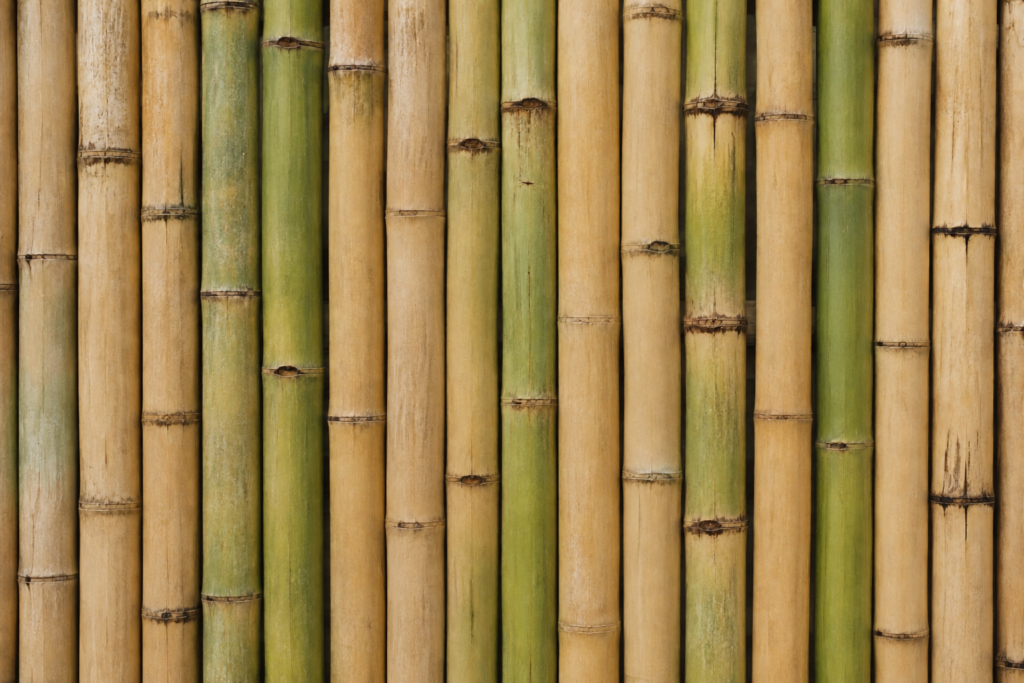
Bamboo has been used as a material for thousands of years, but more recently has hit “trend” status: toothbrushes, bedding, baby cups, furniture… you name it! Anything this popular always gets me questioning:
Is bamboo genuinely an environmental wonder material, or are we simply good at marketing it that way? How eco-friendly can a plant really be, when it is being mass-produced for global demand? Let’s get into it.
The role and many uses of bamboo
First things first: bamboo is not one single material. There are more than 1,600 species, growing naturally across tropical, subtropical and some temperate regions of Asia, Africa and Central and South America. It is technically grass, not wood, although some species can look very tree-like. Humans have found a lot of things to do with it.
Just a few modern bamboo products include:
- Furniture – tables, chairs, shelving and beds.
- Flooring – engineered bamboo flooring is now used in homes, offices and commercial buildings as a cheaper alternative to wooden boards.
- Construction – structural bamboo, scaffolding, panels, beams and housing.
- Textiles – clothing ranging from coats to underwear. Mattresses, towels and bedding. Although there is a big catch here that I discuss in “The not-so-good stuff” section below.
- Kitchenware – chopping boards, utensils, bowls, plates, cups and more.
- Packaging and single-use alternatives – trays, containers and products intended to replace plastics or foams.
- Toys – building sets, puzzles and children’s toys.
- Paper and tissue – bamboo can be processed into pulp for paper products.
- Sports equipment – bicycles, skateboards, fishing rods and other sporting goods.
- Musical instruments – flutes and other mostly-wind instruments.
- Garden products – fencing, decking, plant supports and outdoor furniture.
- Food and drink – bamboo shoots are eaten, while it can also be used in teas and other food products.
- Charcoal and energy products – bamboo can be converted into charcoal, pellets and other forms of biomass.
- Automotive and industrial composites – processed bamboo fibres can be incorporated into composite materials. This can replace fibre glass, metals and plastic components usually used in vehicle interiors, plus lightens the vehicle and lowers emissions. Yanfeng and Ford use bamboo felts and trunk liners to reduce component weight by up to 17%.
- Electronics accessories – device cases and housings have been made using bamboo-based materials.
The International Bamboo and Rattan Organization (INBAR) says more than 10,000 bamboo products and applications have been documented. As you can see above, this spans multiple industries and forms. That variety is important because bamboo isn’t really a new eco trend. It has been part of construction, farming, food, crafts and everyday life in many parts of the world for centuries. What has changed is the scale and sophistication of commercial processing.
China’s bamboo industry, for example, has expanded substantially over the last 50 years, with the amount of land and factories devoted to commercially important Moso bamboo having increased significantly – and still growing!
The environmental journey of bamboo
The bamboo plant itself is generally the “easy” bit. Bamboo grows naturally across huge areas of the world. China and India have the largest shares of global resource and China is by far the biggest exporter of bamboo products, totaling more than US$2bn in 2018, according to the FAO.
Bamboo grows fast and can be harvested at various ages depending on its intended use. Culms (the main stem) then transported to processing facilities, where they can be cleaned and prepared into the product form required. Take bamboo flooring for example: the journey can involve turning whole culms into strips, drying and treating those strips, pressing and bonding them, machining them into boards and finally applying finishing treatments.
Transportation also comes into play: plantation to factory (sometimes more than one, for example separate packaging factories), on to port or distribution centre, then to warehouse followed by retailer, and finally to your front door. This all contributes to the environmental footprint of the product.
Of course, a bamboo product grown and manufactured close to where it is sold is a different environmental proposition from one involving multiple processing stages, fossil-fuel-powered factories and long-distance shipping.
Processing is where the “eco-friendly” title really gets put to the test. A 2022 review of product life-cycles found that bamboo products often have lower global-warming impacts than benchmark materials like plastic or concrete – but the results varied substantially depending on cultivation, manufacturing, energy supply and other assumptions. In other words, “made from a plant” isn’t the same thing as “made with little environmental impact.” I’ve broken this down into more detail below.
Are bamboo products good for the planet?
The good stuff
- It’s renewable
Bamboo can be harvested repeatedly because its extensive underground root (rhizome) system remains intact. This regenerates new shoots, meaning the whole plant doesn’t getkilled like most tree harvests and the land doesn’t need clearing and replanting. FAO and INBAR both identify bamboo as a potentially important renewable resource. - Fast growth and space efficiency
Some species are exceptionally fast-growing. Some larger varieties mature in just 3 to 5 years and produce significantly more raw material per acre than traditional timber. This massive yield limits the total amount of land needed to satisfy industrial demands. - Carbon storage
Bamboo absorbs carbon dioxide as it grows and canstores substantial amounts – the FAO estimates 94 to 392 tonnes per hectare. That said, the actual amount varies significantly according to species, climate, management and site. - Soil protection
Its root and rhizome systems can help bind soil and prevent erosion. Moreover, it can grow almost anywhere, so international initiatives are actively using bamboo to rehabilitate barren land, such as abandoned mines or areas heavily stripped by erosion. - Replaces some resource-intensive materials
A bamboo product isn’t automatically better than everything else, but replacing a high-impact material with a well-designed bamboo alternative can deliver environmental benefits. Life-cycle research suggests bamboo products can have lower global-warming impacts than some steel, concrete and plastic alternatives, although results vary by product and production system. - Supports rural economies
Bamboo already provides income for millions of people, particularly in rural areas, and its value chain can include farmers, harvesters, craftspeople, processors and manufacturers. Workers in bamboo processing factoriesare generally exposed to less air toxins or chemicals than in a plastics or concrete factory (industries bamboo is starting to compete with). This does vary depending on product and standards, with exceptions including some bamboo fabrics which use harsh chemicals to dissolve the plant or some furniture which might use formaldehyde glue.
The not-so-good stuff
- Plantations can damage other growth
Commercial bamboo varieties – most commonly Moso bamboo – can aggressively expand outside farm boundaries, choking out other plants including natives, simplifying landscapes and re-engineering surrounding ecosystems. The rhizome systems and rapid growth make it highly invasive, and ecosystems with just one dominant plant host fewer wildlife habitats and biodiversity.
While bamboo’s rapid growth means most plantations can keep up with demand right now, as the industry expands there’s also a risk that forests and essential marshland will be destroyed to plant more. The Forest Stewardship Council confirms that raw bamboo materials come from responsibly managed forests rather than illegal deforestation areas, and shoppers can check for its tree-and-tick logo. - Processing and shipping still create a carbon footprint
As discussed above, drying, cutting, machining, pressing and finishing all require energy, and shipping generates further emissions. One assessment of structural glued laminated bamboo found electricity was the largest source of production emissions, accounting for 71% of the final emissions in that study. Where possible, buying locally grown – or at least locally processed – bamboo products helps reduce that footprint. - Use of adhesives and chemicals
Engineered bamboo often isn’t simply “piecesof bamboo”. It may contain adhesives, resins, lacquers or other treatments, which add environmental and health considerations and make end-of-life recycling harder. Research is now exploring lower-emission and adhesive-free alternatives. You can also see if it is approved by OEKO-TEX Standard 100, which ensures that finished bamboo goods are tested and free of harmful chemical residues.
- Bamboo fabric poses risks of greenwashing
If your “bamboo” textiles are soft and silky, it is very often rayon or viscose (the US and global production terms for plant pulp) made using bamboo cellulose, rather than fabric made mechanically from bamboo fibres. Producing the pulp involves intense chemical processing, and the Federal Trade Commission has repeatedly taken action against companies that market this as simply “bamboo” or make unsupported environmental claims about it. If in doubt, check how the product describes the material, either on the label or online. If it says “rayon made from bamboo”, viscose or bamboo cellulose, that’s what you’re buying. - Social benefits vary
As above, bamboo can provide valuable rural employment, but the benefits depend on who owns the land, who controls processing and how much value farmers receive. INBAR noted that in developing bamboo industries, especially China, producers can sometimes receive relatively low economic returns while higher-value processing happens further along the supply chain. Unfortunately, this is common in any high-demand, rapidly expanding industry.The Global Organic Textile Standard verifies that textile items meet strict environmental and social criteria, including fair labor practices, across the entire supply chain and lists vendors on its public database. You can also check if a finished product is Fair Trade certified.
- “Biodegradable” doesn’t mean “compostable”
Untreated bamboo is a biological material and can ultimately decompose. Bamboo products are not necessarily equivalent because glues, coatings, dyes and synthetic fibers do not biodegrade in the same way as the bamboo ingredient – some not at all – and should not go in your compost bin. Conditions inside landfill further slow decomposition. - Recycling bamboo isn’t straightforward
For the same reason as above, it becomes much harder to recycle bamboo products that are a mix of materials. Most recycling plants are still not able to separate a lot of the treated ingredients and glues. This is why product design matters so much. INBAR’s work on the circular economy highlights the potential for bamboo furniture to be designed for disassembly, allowing bamboo components to return to biological cycles rather than becoming difficult-to-recycle composite waste.
Don’t get bamboozled
Bamboo replaces a lot of harmful materials and is ultimately a greener option than most plastics or concrete products. It may even be better suited for your needs than slow-growing timber. The science supports plenty of reasons to take it seriously as part of a lower-carbon, more circular economy. However, there are some specific areas where greenwashing has started creeping in as the trend and demand continues to grow. Below are some options that could end up being more sustainable materials in those departments.
For textiles, hemp, linen and responsibly produced cotton can be alternatives worth investigating, especially instead of Rayon. Regenerated fibres such as lyocell can also be designed around more controlled manufacturing systems. The EU Ecolabel assesses textile products across their life cycle and places restrictions on hazardous substances and production impacts.
For furniture, certified responsibly-sourced wood, recycled materials and long-lasting second-hand furniture could all beat buying a bamboo product that uses a lot of synthetic treatments, coatings or formaldehyde glue and does not disassemble for disposal.
I’m excited by bamboo and all its potential uses, as well as the environmental improvements it is already offering by providing material alternatives across many industries! It’s merely worth remembering that there isn’t one magical “best” sustainable material.
Keep reading the labels and stay curious about new materials and green marketing. At the end of the day, the better choice is always personal because it depends on what you are buying and how you intend to use it.