I think the UK still sometimes operates with the mentality that we’re doing just fine on our own – Rule, Britannia! and all that. We have a centuries-long history of being a world leader, setting the tone for industry, innovation, policy and what’s important. This can generate habitual thinking that we don’t need to follow anyone else’s way of doing things, or we know best. But when it comes to sustainability, other countries are pushing forward initiatives that are, frankly, the envy of the world. They say no one likes a copy-cat, but several of these actions are so straight forward I can’t help but wonder: why don’t we implement that here?
I’m going to focus on Europe, simply because it is geographically and somewhat politically close to the UK – sustainable actions undertaken there could perhaps more likely be tweaked to work here. Now, even as I write that, I know the UK is no longer officially part of the EU, and its legal sustainability requirements are starting to differ. Since Brexit, the EU has introduced 28 new or revised environmental policies that the UK has not adopted. The UK is also diverging on chemical regulation (UK REACH), water quality standards and nature protection, and is replacing directive rules with new, less stringent planning requirements.
So, to clarify, I’m not talking about matching overseas policy but simply copying standalone actions that appear to be working well, which just happen to fall under other countries’ policies. I’m no expert, but below are just a few examples of actions I think the UK could adopt quickly and efficiently, without needing a 20-year-plan or completely revamping existing policy.
Doable sustainability actions (that the UK could steal)
Solar panels on car parks – France
In 2022, France passed a law requiring large car parks (80+ spaces) to be covered with solar panels. The aim is to generate up to 11 gigawatts of power while shading cars from heat and weather. This is a win-win. It is not taking up farmland and uses already-developed land. Cars stay cooler and protected from the elements, while energy production increases. It’s a practical action that doesn’t require people to change their habits overnight. Around the same time, the French government also launched a communication campaign, “every gesture counts”. This encourages individuals and industry to cut their energy usage, and the Eiffel Tower lights are being turned off more than an hour earlier. Small changes making a collaborative difference.
Recycling deposit return schemes – Germany
Germany has one of the most successful bottle deposit systems in the world. When purchasing a drink, shoppers pay a small deposit (the Pfand) on bottles and cans. They get this back when they return them. Multi-use containers (often made from glass or PET plastic) have producer-set deposit prices ranging from €0.08 to €0.25, while single-use containers have a government-fixed deposit price of €0.25. You can then return your empties into machines located in most shopping areas and supermarkets to be reimbursed. Through this system, Germany achieves recycling rates of up to 98% for some beverage containers. The UK has been planning a recycling deposit return scheme for years, which has been repeatedly pushed back (so far by more than four years). It is now expected to start in October 2027. Fingers crossed.
Rewilding the Danube Delta – Romania
In Romania, large-scale rewilding projects are restoring wetlands in the Danube Delta. Restored wetlands absorb carbon and reduce flooding, which also strengthens nearby residential areas. The efforts also support biodiversity and the return of various species to the landscape – restoring natural grazing and enhancing food webs. Additionally, this action has created many education programs and social activities for citizens. The UK, with its flood-prone regions, could expand similar wetland restoration in areas like the Somerset Levels.
Joint rewilding of the Oder Delta – Germany and Poland
Similarly, Germany and Poland are working together to help rewild the Oder Delta. This achieves the same environmental benefits as the above progress on the Danube Delta, but stands out because it highlights collaboration. Nature doesn’t recognise political boundaries and projects like this prove that cross-border environmental cooperation works. The UK unavoidably contributes to global pollution, especially in neighbouring areas. Just because it leaves a political union doesn’t mean it should suddenly have no responsibility to address such problems. With that in mind, post-Brexit UK could still collaborate regionally on North Sea and Atlantic marine restoration.
Free public transport – Luxembourg
In 2020, Luxembourg became the first country to make public transport free nationwide. The country had more cars per 1,000 people than anywhere else in the EU. Its aim was to have 20% more passengers on public transport within five years (COVID-19 skewed these results so the measurable time-period has been extended). A move like this reduces car dependency and congestion, simplifying commuting for citizens and lowering individual emissions. While free nationwide travel may be ambitious for the UK, targeted free travel zones (city centres, for example) could work.
Cycling infrastructure – Netherlands
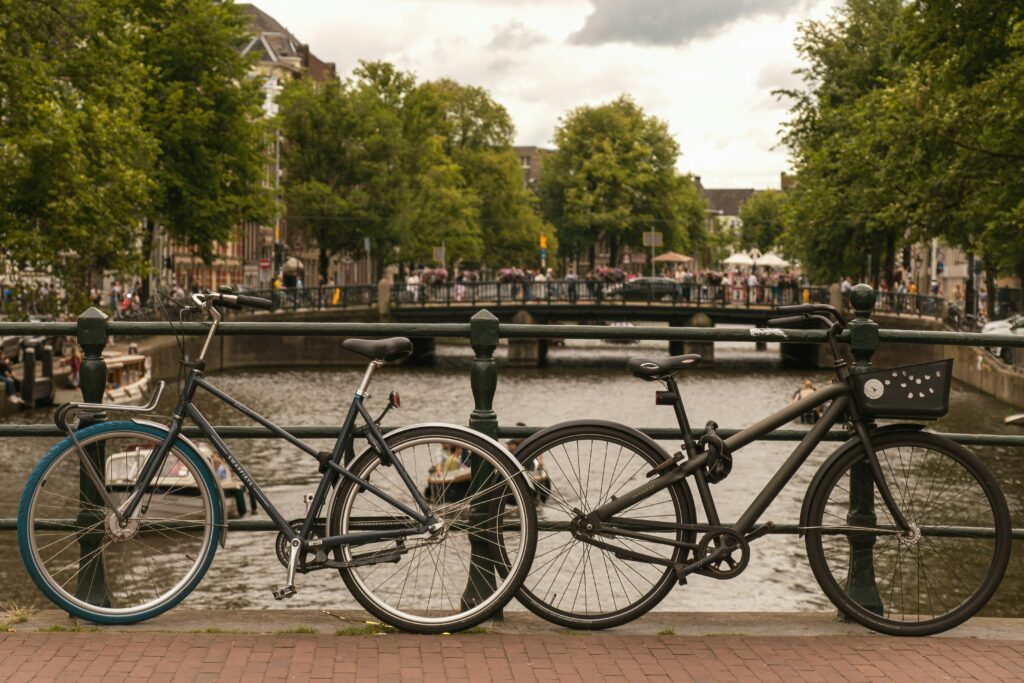
The Netherlands is a world leader when it comes to investing in cycling highways and safe bike infrastructure. Bicycles fulfil more than one quarter of the country’s overall transport needs and it boasts a finely meshed network, featuring 35,000 kilometres of bicycle tracks. Safe infrastructure encourages everyday cycling, which is good for the environment (lower emissions) and for citizen health. London is full of cyclists, but I can personally vouch for the fact that some of its “dedicated cycle paths” get shared with rush-hour traffic and feel like a deadly obstacle course. Even outside of London, maintenance of UK cycle paths is hit or miss. We could certainly accelerate work on protected cycle lanes in cities, without reinventing the wheel.
Food waste laws – France
Back to France – large supermarkets are banned from throwing away unsold food and must donate it. This requirement proved so popular that it was extended to include food service, restaurants and institutional catering as well. It means that food waste decreases, charities and lower-income citizens benefit and emissions linked to waste are reduced. The 2016 goal was to reduce the country’s food-waste by 50% by 2025. The progress is currently being calculated, but the action has already secured France’s title as a world leader on the issue. The UK already has some voluntary agreements on food-waste and charities are actively seeking more connections. Businesses that do volunteer have proved it works here and is not difficult or expensive to maintain, so a more formal plan could easily strengthen Britain’s progress on this.
Urban green roof mandates – Switzerland
Basel in Switzerland boasts the world’s highest green roof area per capita. All new and renovated flat roofs must be greened. Incentive programmes provide subsidies for doing so, including retrofitting existing buildings. Green roofs reduce urban heat, absorb rainwater and improve biodiversity. The government expect it will help lower temperatures and reduce surface runoff around the city. Several European countries and cities have been adopting similar measures recently, so why not the UK? Several of our cities, including London, have measured year-on-year increases in deadly summer heatwaves and more flooding in winter. We already host an abundance of flat-roofed buildings and planning policy tweaks in the UK could deliver this quickly.
Car-free city centres – Spain
Barcelona in Spain has introduced “superblocks” – limiting traffic inside neighbourhood grids. Up to nine city blocks in highly-populated, residential areas get combined into dedicated sections, where pedestrians and cyclists have priority and flower-beds, fountains, benches or playground and exercise equipment are installed. Car access is either limited to one-way or redirected down existing parallel roads. This creates more safe spaces for kids to play and families to relax, strengthens community pride, slightly lowers pollution such as vehicle emissions, improves surrounding house prices, and even boosts business sales in those areas by up to 30%. While London is working on a Pedestrian Priority Streets Programme, these tweaks are not as deliberate nor deliver such dedicated spaces, and are not having as notable positive impacts. Why not adopt a similar model to Spain, across UK cities?
Inspirational (bigger, longer-term) ideas
The next ideas are more ambitious. They’re expensive, require planning reform, political will or public buy-in, but they’re also worth understanding. At the least, they can inspire us to think in a way that prioritises long-term sustainable social practices.
Right to Repair
In 2024, the European Union strengthened Right to Repair legislation. Products are not lasting as long as they used to, and consumers are opting to throw items away instead of repairing or reusing them. (We briefly touched on this in an article about modern gift-giving). The number of entire products appearing in landfill is increasing. Meanwhile, higher demand for replacement products means greater emissions from manufacturers. It is also difficult for consumers to know how to recycle certain items: say a vacuum cleaner or pram is broken – you can’t donate it, but it also uses multiple materials which are not designed to easily come apart. What do you do? For most busy households, convenience of the “big bin” wins again.
The Right to Repair legislation tackles this issue from both sides. On the manufacturer’s side, new legal requirements help ensure they make longer-lasting products, offer lengthy repair warranties, design products for ease of disassembly when needed, and are encouraged to use sustainable materials or offer access to affordable replacement parts. On the consumer side, they must be motivated by companies to repair rather than replace. This could include being provided at-home-repair tools, easier return-for-repair processes or offered cheaper repair prices after warranty periods expire, to name a few options.
Longer product lifespans reduce waste, save families money and in the long-run reduce manufacturer emissions. The UK desperately needs to take action for such changes. Currently we are the second-highest producer of e-waste per capita on Earth, producing 24 kg per person per year. Unlike the actions listed earlier, this would require agreed action at multiple levels to occur before the desired change rolled onto consumer behaviour. It would require government backing for manufacturers to make noticeable changes, but the EU has proved it is possible and the UK could independently pursue similar legislation. The Start Project is pushing for a version of Right to Repair to exist here and lists some actions you can take to help make that happen.
15-minute cities
The concept of the 15-minute city means residents can access work, school, shops and green or leisure space within a 15-minute walk or bike ride. Public transport routes are tweaked to better service these areas too. Paris has redesigned some neighbourhoods under this model. Less commuting and more direct public transport means lower emissions, and more walking or cycling means healthier residents. This also strengthens local economies and communities even more than superblocks do.
It obviously requires large-scale commitment to urban planning, especially if it is going to take place in major existing cities. Implementing such changes might cause prolonged traffic disruption, so I’m not necessarily suggesting we follow that exact model blindly. However, Oxford has already explored similar ideas that are personalised for its infrastructure, proving the idea is adaptable for parts of the UK. As cities and towns continue expanding, why not do so with an approach that more actively prioritises sustainable urban planning?
Garden cities
The UK once built communities called garden cities, intended to create economically strong and fairly self-sustainable areas that still had the feel of rural living. They were visionary – set around a park with housing, gardens and green walkways circling out. Businesses and transport were primarily locally run, each city prioritised recreational venues, accommodation prices were capped by councils to be in line with local wages, and populations were limited to around 32,000 to avoid overconsumption or crowding and maintain the housing quality. Letchworth Garden City became the first in the world.
The UK’s idea was on the more extreme side and it didn’t take off as much as it could have, had it been more adaptable. It’s a dreamy concept for young families or pensioners, but inflation, increasing population and widening career interests make it hard to keep residents for long or to sustain such exclusive numbers. That said, the original garden city concept promoted building with sustainable materials, and the limited infrastructure meant council resources could better cover upkeep. It’s sad that the UK still has not learned from this: if you mass-build infrastructure, it will degrade and all need repair at the same time. UK cities face this constantly, from council buildings that no longer meet modern regulations, to sewage or transport systems that take dozens of years and millions of pounds to mend. Councils are struggling to stay on top of it, so perhaps there is something to the idea of limiting how much they are each responsible for.
These days, Europe experiments with eco-towns and sustainable districts far more than the UK does. Yes, it costs money, but so does retro-fitting outdated infrastructure forever.
Sustainability is not a solo sport
When it comes to sustainability in Europe, there is no shortage of inspiration. Our neighbours are proving that environmental progress can be practical, economically sensible and resident-friendly. Sustainability shouldn’t be something we do internally to feel morally superior. It should be a collaboration and shared learning process. Just because something has worked in the past or meets our country’s current legal requirements, doesn’t mean it’s the best we can do. As humans keep deteriorating the planet, those requirements are going to need to expand anyway.
Our understanding of the environment and ability to do better is constantly evolving. Europe is already showing us what works. The question isn’t whether we can adapt. It’s whether we’re willing to.