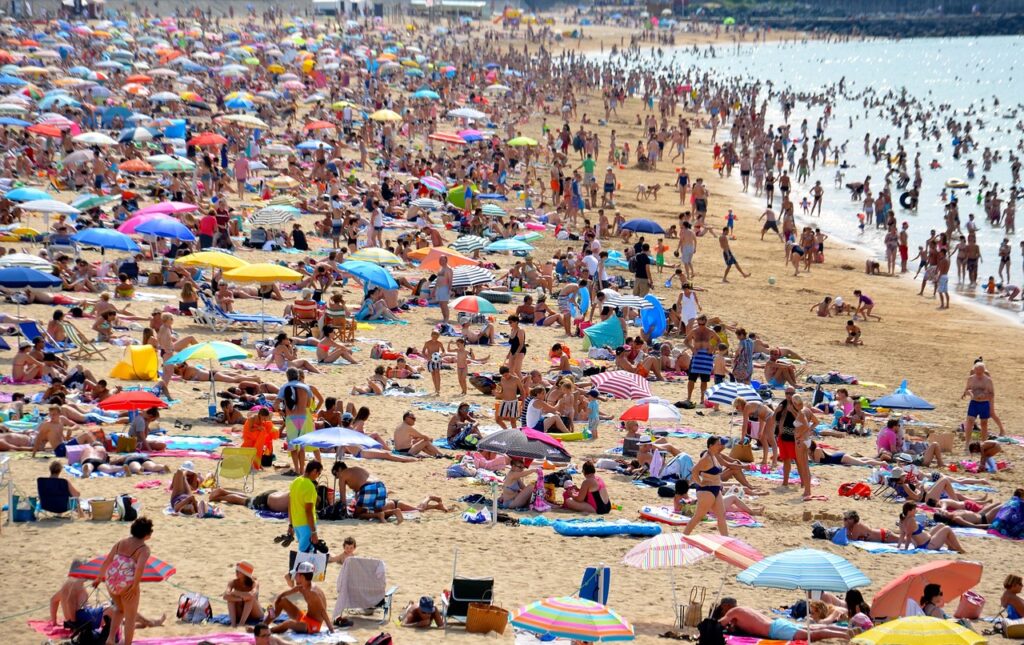
The global human population currently stands near eight billion people and is projected to rise before hopefully stabilising later this century. How should we interpret this growth and what does it means for the environment, economy and daily life?
This article explores two contrasting perspectives on population growth, the research behind them and what life might be like if either trajectory dominates. One says we need to reduce growth for the sake of the planet, and the other argues that the population can continue rising and still be sustained. I’m not writing as an expert, nor to argue for a particular angle, but as someone eager to learn more. Let’s crack on and see the general points of each.
The case for population limits
Some research argues that continued population growth at current or projected rates places significant strain on Earth’s finite systems — and that without reducing population numbers or consumption patterns, environmental and social problems will intensify.
Why is it a problem?
An increasing number of people produces higher demands for fundamental resources – food, water, energy – and produces more waste and emissions, which can degrade ecosystems and contribute to climate change. Resource depletion, pollution and habitat loss crop up in numerous analyses of population-driven environmental stress. As the population rises, humanity’s resource use outpaces resource regeneration, leading to land degradation, water scarcity and biodiversity loss. This is especially common in regions with high consumption and rapid development. Many experts argue that the connection between production, environmental limits and population creates obstacles to sustained growth because increased resource use tends to increase pollution and environmental deterioration. Population growth also interacts with climate change – more people generally means more greenhouse gas emissions, unless consumption and energy sources radically shift.
What are the key issues that need addressing?
The concept of carrying capacity (the number of people the Earth can sustain at a given standard-of-living) suggests there may be limits beyond which environmental systems cannot support the population without collapse. Carrying capacity is a key component in the ‘Limits to Growth’ idea, which argues that exponential human and industrial growth on a finite planet will eventually hit limits, potentially leading to decline or crisis. Another idea is ‘Overshoot’, which suggests humanity may already use more resources than Earth can regenerate annually. This is decerned by measuring things like ecological footprints. Different estimates of human carrying capacity vary widely – from less than four billion people under a “reasonable standard of living” to assumptions of tens of billions under “what is physically maintainable”. Resource limits and environmental goals have already been put in place by many countries. Many experts have also suggested interventions such as expanding access to reproductive healthcare, education and family planning, particularly in regions with high fertility rates. These are often proposed as humane and voluntary ways to slow growth and improve individual wellbeing. The ‘World Scientists’ Warning to Humanity’, co-signed by thousands of scientists, explicitly calls for a stricter limitation of population growth, along with reducing consumption of fossil fuels and other high-impact activities to improve environmental sustainability.
The case for continued growth
On the other side of the debate are researchers, economists and technologists who argue that population growth is not unsustainable, provided that society invests in innovation, efficient systems, and adaptive policy – and that challenges are as much about consumption patterns and inequality as raw population numbers.
Why is it not a problem?
A key belief is that human ingenuity and technology can counter population growth from causing environmental harm. This could be achieved in part by advancing agriculture to produce more food with fewer inputs, such as precision farming or improved crop genetics. It could also involve energy innovations, such as renewables, storage technologies and possibly new sources like fusion – which could dramatically lower the carbon footprint of a larger population. Some research on the relationship between innovation and population suggests that moderate population growth can actually support sustained technological output, which in turn drives solutions.
What are the key issues that need addressing?
Multiple scientific assessments suggest that feeding a much larger population is technically possible, but only with major changes. For example, analyses show that feeding a projected 10 billion people by mid-century could be achieved if agriculture and diets are transformed, food waste is cut dramatically and production efficiency improves. Research also highlights that shifting diets toward more plant-based foods and reducing waste can significantly alleviate pressure on land, water and emissions. Some models estimate that the Earth’s carrying capacity isn’t a fixed number and cannot be known precisely; it depends on technology, consumption norms and human choices. Other studies have found that it’s possible to feed 10 billion people sustainably, but requires a “technological and socio-cultural U-turn,” meaning major structural changes in farming and food distribution. Another set of arguments focuses on the demographic transition. This is the observed pattern where rising wealth and education correlate with lower birth rates over time. Some advocates believe that as countries develop, population growth naturally slows, making environmental concerns less severe. Others argue that underpopulation – or extremely low birth rates – could pose challenges too, such as labour shortages and higher dependency ratios in ageing societies. The debate in social science suggests that population size impacts but doesn’t fully determine economic outcomes, with education, skills and technology often playing larger roles in prosperity.
What life might look like if population continues growing
If the global population continues rising toward or beyond 10 billion this century, much research clearly predicts that certain elements of life will need to shift, including food systems, energy, waste and housing.
The planet’s food system will need to evolve with sustainable intensification – producing more calories per unit of land while minimising environmental impact. Changes in diet will need to happen, especially reduced consumption of resource-intensive foods like red meat. Food waste reduction and smarter distribution systems would also be critical, potentially lowering the total food production needed by significant margins. On the energy front, to meet the needs of a larger population while reducing emissions, large investments in renewable energy infrastructure would be necessary – including solar, wind, hydroelectric and next-generation nuclear. Energy systems might become increasingly decentralised, with local microgrids and community energy storage required alongside larger-scale networks. Managing waste (organic, plastic and industrial) at much increased scales will require innovation in recycling, circular economy models and material reuse. Policies to reduce consumption intensity (especially in high income regions) could reduce the per capita environmental footprint, easing the pressure of more people. Lastly, large urban populations would demand densification, efficient public transit and sustainable housing to limit sprawl and land loss. Cities may increasingly become models of efficiency with vertical farming, smart grids and water recycling systems. These are only some of the main topics that would be impacted.
What life might look like if population growth slows or declines
If population numbers stabilise or decline, whether through demographic trends or policies, some general patterns might emerge. Again, I’ve only covered the most common predictions here, spanning policies, economy, ecosystems and industry.
Some estimates suggest Earth could sustainably support a population well below current numbers if a high standard of living is assumed and global consumption patterns remain unchanged. Others show much higher limits if technology and lifestyles evolve. Debates over what constitutes a “reasonable standard of living” complicate any precise carrying capacity number. This would be needed as a starting point for any fundamental policy to be put in place. That said, voluntary policies might occur, such as increased access to education, reproductive healthcare and gender equity initiatives. These are seen in many demographic transition frameworks. Other proposals have suggested incentivising smaller families through taxation, benefits or social norms. However, such policies raise ethical and cultural questions, as they would be implemented differently by different nations and generally do not target citizens equally. A stabilised or smaller population could reduce pressure on ecosystems, potentially giving habitats and biodiversity more space to recover. Economically, regions with low fertility rates may face ageing populations and labour shortages, which could necessitate automation, immigration reforms or changes in social welfare systems. Industries tied to fossil fuels, unsustainable agriculture and high-impact production could shrink, while clean energy, circular economy and care-based sectors grow. Slower population growth might shift investment toward human capital and resilience, including healthcare, education and sustainability practices.
Conclusion: two views, one future
In writing this article, I have learned that the question of whether population growth must be reduced or whether humanity can sustain a growing population, is not one with a single answer. Instead, I’ve uncovered various views, grounded in different assumptions about human creativity, technology, values and the definition of sustainability. On the “limits are needed” side: population growth is tied to resource use, environmental degradation and climate stress. Many arguments suggest there are physical and ecological thresholds beyond which systems falter, and policies that slow population growth are seen as tools to reduce long-term risk and improve resilience. On the “we can adapt and innovate” side: growth can be sustained if technology and policy keep pace with demands. Investments in sustainable food, energy, cities and cultures might enable more people to live well. Population size is only one component of environmental impact – consumption patterns and equity are equally crucial.
The reality could possibly be a blend of both. Across the board, researchers seem to predict that population growth will slow in some regions as fertility declines naturally, and that sustainable innovation will be needed to support larger populations in others. What is clear – from social science, environmental research and demographic projections – is that both human choices and systemic design will shape the future of this debate. It’s an important conversation to have with a lot of elements to consider. (I’ve only briefly touched on some of them, otherwise we’d be here all day!) But whichever way things go, action is needed, not just words.