
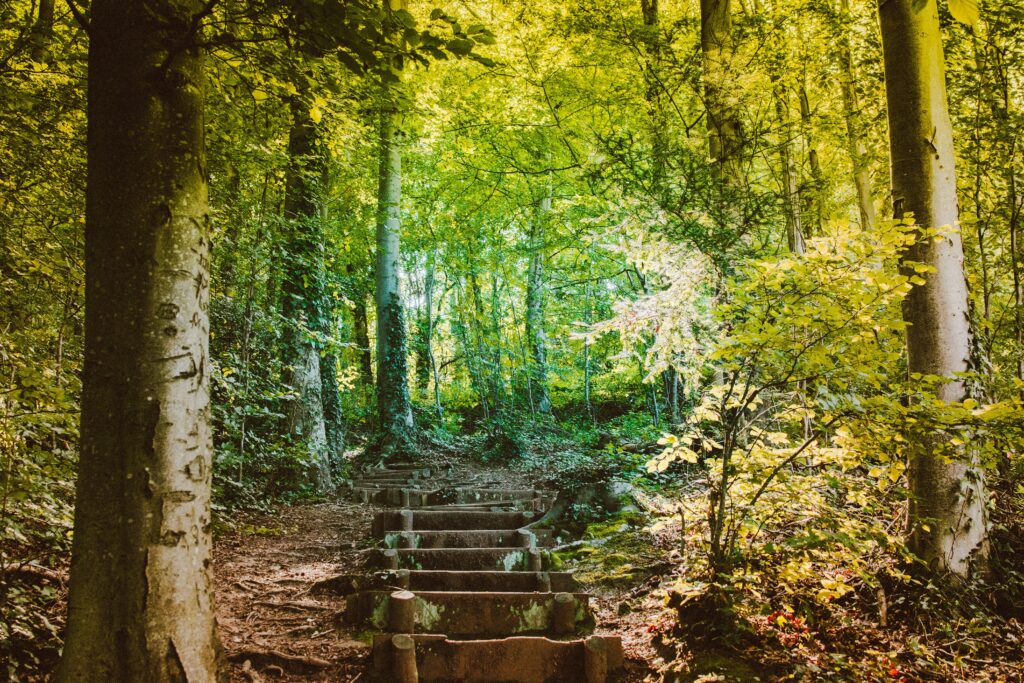
London is famous for its theatres, museums and skyline – but just beyond the busy streets lies another side of the city: forests. From ancient woodlands to royal hunting grounds, they stretch across Greater London, quietly supporting wildlife, cooling neighbourhoods and offering people a peaceful escape.
If you live in the city, you’re never as far from a canopy as you might think. These forests play an important role and are endless fun to explore! The sun is finally shining in the UK, and it is the International Day of Forests on 21 March 2026 – what better time to discover the ancient wonders right on your doorstep!?
Why forests near cities are so important
Forests near urban areas are vital spaces. They act as green infrastructure, helping ecosystems function even in man-made environments. Crucially, they support biodiversity by providing habitats for birds, insects, fungi and mammals. Even relatively small woodland areas can act as stepping-stones between larger habitats, allowing species to move across the city and supporting London’s diverse ecological communities.
They also help regulate temperature. In dense cities, buildings and asphalt absorb heat, creating the “urban heat island effect.” Woodland helps counter this through shade and evapotranspiration. (Yes I had to google that word – it means when water evaporates from leaves and cools surrounding air).
Another benefit is water management. Forest soils absorb rainfall and slow runoff, reducing the risk of flooding and improving water quality by filtering pollutants before they reach rivers and streams. Urban forests also contribute to climate change mitigation. Growing trees capture carbon dioxide and store it in wood and soil. Even though individual city forests are small compared with global forests, together they still play a meaningful role in urban carbon storage.
As the world becomes more urban – with two-thirds of people projected to live in cities by 2050 – urban forests will become increasingly important refuges for wildlife and people alike.
Why people need forests too
It’s not just the wildlife that benefit either – many researchers now describe access to nature as essential infrastructure for public health. Spending time in forests has been shown to reduce stress and anxiety and increase positive mood. Walking among trees encourages physical activity, lowers blood pressure and provides a restorative environment where the brain can recover from constant digital stimulation.
Socially, they also offer a (usually free) place to exercise, relax and reconnect. Plus, there’s something special about forests compared to parks. Some research suggests people living near larger forests show healthier stress-regulating brain structures than those surrounded only by urban green space. In other words: forests don’t just help cities survive – they help people thrive.
London’s ancient forests: living history
Some of these areas aren’t just green escapes, they’re historical landscapes. In the UK, “ancient woodland” is defined as land that has been continuously wooded since at least the year 1600.
That date isn’t random. It reflects the point when detailed maps began appearing, allowing historians to confirm that certain woods have existed for centuries. If a forest predates that moment, it’s considered ancient because its ecosystems developed long before modern agriculture or industry reshaped the landscape. These forests are biologically special because they have had hundreds, sometimes thousands, of years to evolve. Ancient woodlands contain:
- Rare fungi and mosses that depend on undisturbed soil
- Insects that rely on ancient or decaying trees
- Plants that spread slowly over centuries
- Unique soil ecosystems built up over long periods
Because their soils and ecological communities develop so slowly, ancient forests are often described as “irreplaceable habitats.” They also store huge amounts of carbon. Even though they represent just a quarter of the UK’s woodland area, ancient forests hold around 37% of the carbon stored in British woodlands.
Globally, truly old-growth forests are becoming rare due to deforestation for farming, industry and development. The fragments that remain – especially those embedded in historic landscapes like the UK – are ecological treasures. They cover only about 2.5% of the UK’s land area.
When you think of it that way – it’s beyond impressive that London still has access to any ancient forests, let alone several of them!
Forests to explore near Greater London
Here are some of the most important forests in and around Greater London – each with its own ecological, historical and cultural story.
Epping Forest
Location: Northeast London and Essex
Distance from central London: ~17 km
Public transport: Yes (Central Line to Epping, Loughton, or Chingford)
Stretching for nearly 6,000 acres along the edge of London, Epping Forest is one of the city’s most famous natural landscapes. The woodland has apparently existed in some form since trees returned after the last Ice Age more than 10,000 years ago. King Henry (I) designated it a royal hunting ground in the 12th century, and deer hunting shaped its landscape for hundreds of years.
One of Epping Forest’s most remarkable features is its 55,000 ancient trees, the highest number at any single site in the UK. Many of these trees were historically “pollarded,” meaning branches were regularly cut above grazing height to harvest wood without killing the tree. This traditional practice created hollow trunks and complex structures that today support rare fungi, insects and bats.
The forest nearly disappeared in the 19th century when landowners began fencing sections for private use. After protests and legal battles, the Epping Forest Act of 1878 began, protecting it for public enjoyment – a landmark moment in urban conservation. Today the forest is crisscrossed with walking paths, ponds and cycling routes. While roads and nearby suburbs have changed its surroundings, many areas of woodland still feel untouched.
Richmond Park and woodlands
Location: Southwest London
Distance from central London: ~13 km
Public transport: Yes (Overground and bus connections)
While Richmond Park is best known for its open grasslands, it also contains important areas of woodland and veteran trees. Originally created in the 17th century by King Charles (I) as a deer park, the site spans 2,500 acres. Ancient trees scattered across the park – particularly oaks – support extraordinary biodiversity, including rare invertebrates and fungi that depend on decaying wood.
Grazing deer have been present there for centuries, so parts of the park resemble historic “wood pasture” – an ancient form of landscape combining trees and open grassland. Richmond Park was designated a National Nature Reserve in 1992 and remains one of the best places in London to see wildlife. Despite nearby urban development, the park’s centuries-old ecosystem remains remarkably intact.
Burnham Beeches
Location: Buckinghamshire, west of London
Distance from central London: ~35 km
Public transport: limited, easier by car
While it is further to travel, this is worth it! Burnham Beeches feels like stepping into a fairytale woodland. Its twisted beech trees, moss-covered trunks and quiet glades appear in dozens of films, such as Harry Potter, Robin Hood and the Princess Bride.
The woodland dates back centuries and was once part of royal hunting forests used by medieval monarchs. It became protected as a nature reserve in the early 20th century and is now managed by the City of London Corporation. Its ancient beech pollards support species found in very few places in Europe. The forest once covered a much larger area, but conservation efforts have fought to preserve what’s left.
Hainault Forest
Location: Northeast London
Distance from central London: ~20 km
Public transport: Yes (Central Line to Hainault)
Hainault Forest is a fascinating survivor of the medieval Forest of Essex, once a huge hunting landscape stretching across much of eastern England. In the 19th century, most of the forest was cleared for agriculture. Only fragments survived – today forming Hainault Forest Country Park.
The remaining woodland contains ancient oak and hornbeam trees, along with meadows and wetlands. Historically, local communities used the forest for grazing livestock and gathering firewood. Today it is protected as a nature reserve and public park, with dedicated recreational areas. While the forest is far smaller than it once was, conservation projects are working to restore habitats and increase biodiversity.
Ashtead Common
Location: Surrey
Distance from central London: ~25 km
Public transport: Yes (train from London Waterloo)
Ashtead Common is one of Britain’s most important sites for ancient oak trees and pollards. It’s 500 acres host more than 2,300 of them, with several dating at over 300 years old. They home around 1,000 beetle species (130 of which are nationally rare) and 90 bird species (40 breeding regularly), such as tawny owls and green woodpeckers.
While the trees provide essential habitats for wildlife and the common historically grazed livestock, the park itself features a rare habitat of another kind: a Roman villa. The building site can be found alongside a historical Roman road (Stane Street), with evidence of human activity dating back to 2000 BC. Ashtead Common was acquired by the City of London in 1991 and these days is protected as a designated National Nature Reserve and a Site of Special Scientific Interest.
What has changed – and what hasn’t?
London’s forests have changed dramatically over centuries. Many were once royal hunting grounds and vast grazing commons. Urban growth has reduced their size, introduced roads and railways and changed wildlife populations. Yet some things remain surprisingly constant.
Ancient trees still grow where medieval farmers once gathered wood. Pollarded trunks still shelter rare insects and fungi. Walking through these forests today, you may follow paths that people have used for hundreds of years. These forests are not untouched wilderness – but they are living landscapes shaped by both nature and history…and they are right on your doorstep!
The wild side of London is waiting
Living in a city doesn’t mean living without nature. It blows my mind that within an hour of central London, you can wander through woodland older than some countries! These forests have helped wildlife survive hundred of years, despite cities being built right amid them. They also help cool that city, clean the air and quietly support our mental health. What do we do for them? If you want to help protect them, you can search for site-specific volunteer groups or visit the Woodland Trust.
London might be an ever-expanding hustle and bustle of constant change, but hopefully – thanks to conservation efforts – these rare and peaceful gems aren’t going anywhere fast. Next weekend, why not grab your walking shoes and go to see one for yourself?