Filmmaking as Therapy: The Conversation I Couldn’t Have

Filmmaking as Therapy: The Conversation I Couldn’t Have

There are conversations we know we need to have but also know we can’t. Not because we don’t care. But because we care too much about what we might lose if we say the wrong thing.

In early 2025, I made a seven-minute musical film in 48 hours. It’s called “If You Don’t Act, Then Were You Even Here”. 

Coming up to the shooting day, I went back and forth on what the film should be about. I believe that character-driven films are the most watchable. Regardless of the world and the events around them, if the characters feel real, the actors will have clarity and hopefully the audience will catch their emotions related to whatever the characters are experiencing in the film. 

So, I wanted to try Mike Leigh’s method of creating a story by first creating the characters with the actors and putting those characters in various situations, then assembling the story. 

I didn’t start off with those characters in mind, but in the months prior to the challenge, I had spent many a night going back and forth in my mind, having variations of this conversation with people. 

So naturally, the film became a place to explore this conversation, the conversation that I felt I couldn’t safely explore in real life.

The 48-Hour Film Challenge

The challenge was organised by Action on the Side, a filmmaking club for people of all skill levels, usually making films, while having another occupation. 
 
The competition was announced letting us know that the constraints would be – write, film, edit and submit the film within 48-hours, between midday on Friday and midday on Sunday. Everyone on the team had to be a volunteer, the budget had to be zero and we would have to include certain elements that would only be communicated to us on the Friday before kick-off. Those were: the genre, a specific line of dialogue, a prop, and a camera movement. 
 
These constraints are so you don’t have the option to write the script or start filming in advance.  
 
We had a few weeks to find our team. This part was hard. Experienced filmmakers don’t usually have time to join such challenges, and inexperienced ones can be unreliable. Luckily, actors are keen to participate in such projects because of the quick turnaround. 
 
So as soon as I had locked Esther O’Loughlin and Rich Allen we started discussing characters. 
 
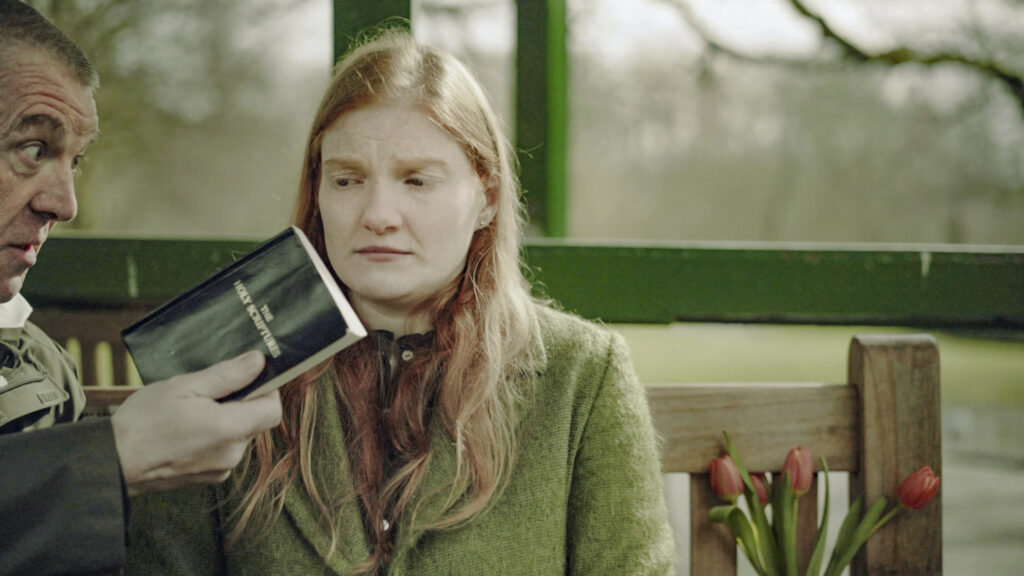
I didn’t set out to make a “statement film”. Having their ages and looks in mind, I jotted down all sorts of job roles and relationship combinations. But considering the frequent imaginary arguments I was going to sleep with at that time, I decided on one of the characters being a vicar and on both of them being Christian, having this theological argument. 
 
The actors worked hard to internalise their opposing value systems, and in the case of Rich, David’s value system was quite far from his own. 
 
After an improv session with Esther and Rich, we worked through the backstory and decided on David not just being her spiritual father but her actual dad, who she loves and spends time with. 
 
When we drew the Musical genre, the actors quickly came to the decision that they’d rather sing than dance, we came up with the idea to rewrite the lyrics of old hymns, and we chose the singing style of Les Misérables, as we didn’t have an instrumentalist on the crew or the budget for set pieces like those in Lala Land for example. It would have been fun though, maybe on the next one!
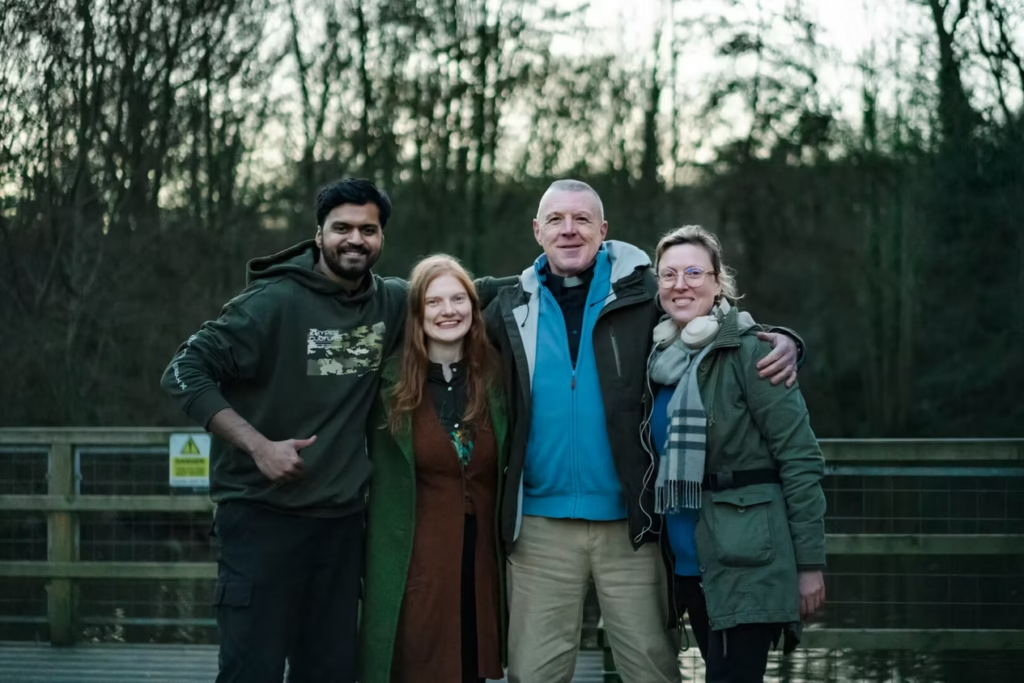
If You Don’t Act, Then Were You Even Here - cast and crew
Denver Dion D’Souza (cinematographer), Esther O’Loughlin (Clara), Rich Allen (father David), Cathy Kostova (Writer/Director)

“The Letter You Never Send” & The Rehearsal

My inspiration for using the medium of film to process a difficult issue didn’t come out of nowhere. Processing our emotions through art and writing is not a new concept. I have written several letters, the kinds of letters I never intended to send. 
 
“The Letter You Never Send” is a common therapeutic writing exercise recommended by counsellors to use as a reflective practice. If you write by hand, it has some EMDR qualities as well. 
 
The practice is to write a completely honest letter to a person you have strong, unresolved feelings towards. You say everything you would never feel safe, polite, or brave enough to say to them in real life. You don’t edit for kindness. You don’t try to be fair. You don’t try to be diplomatic. The goal is to get your feelings on the outside.
 
The letter is never sent.
 
Around that time, I had come across the HBO TV Series The Rehearsal. The first season is fascinating and I strongly recommend it. 
 
It’s a documentary-style series created by Nathan Fielder in which he helps ordinary people prepare for difficult real-life conversations. His team creates elaborate like-for-like sets of where the conversation will take place, hires and directs actors to perform the other people around and the subject and an actor playing the other side runs the conversation repeatedly. They go through all possible variations, so they feel safe to have it in real life. 
 
I didn’t go through all the variations with my actors, but I did write out their dialogue several times and on the story day, we had to rewrite it all again to make it into a musical. And believe me, I had some ideas in my back pocket, in case the competition gave us the genre of sci-fi or horror too.
 

The Conversation I Can’t Have

Even though I’ve gone through this process and this particular issue doesn’t keep me up at night anymore, I still don’t feel comfortable confronting these theological differences in person. 
Possibly, because I went down the fiction route with the film and I didn’t do what “The Rehearsal” does. 
 
I don’t know. 
 
But I am still afraid that if I voice these things out, I could be excluded from the group. Because I often hear “watch out for those who cause divisions… keep away from them.”
 
There is a lot of tension between what I believe about caring for our world and what I am still hearing around me, thrown around carelessly, as verses picked out of context. The tension between caring for this world now and believing this world doesn’t matter because heaven is what counts: “Set your mind on things above, not on the earth”, “save souls for heaven”, “focus on your own sins, not institutional injustice”, “God has it covered”, “it is by grace you will be saved… not by works”.
  
So, I don’t know how to start the conversation without it becoming conflict.
 
Art feels safer than speech. So, I made a musical. 
 

Why Fiction? Filmmaking, Puppets, and Therapy

Writing and filmmaking are my go-to artistic expressions, but you don’t have to be an experienced filmmaker to try the positive benefit of reenacting difficult situations.
 
Roleplaying is our most intuitive way of processing emotions. Left to their own devices, children use their toys to go and rerun conversations they’ve heard or been part of. If we did that more as adults, outwardly, not just in our heads, we’d process our difficult emotions too. 
 
Writing is fantastic and free but not everyone can sit and focus in front of a blank page. Some of us need something more visual and tactile. 
 
We can use our kids plus toys or puppets and throw ourselves into silly improv. We can play all characters or grab a friend or our partner and roleplay each other or other people. 
 
Made-up characters can say what we can’t. 
 
Making up songs helps too, singing lowers our guard when we’re feeling too self-conscious even if we’re by ourselves. 
 
And if we end up recording let’s say a puppet show, for our own or the entertainment of others, even if our characters are fighting with each other, this adds to the power of storytelling. 
 
Fiction creates emotional distance that makes truth easier to digest without our viewers feeling attacked for seeing things differently. 
 

Watching It Back and What I Learned

Watching “If You Don’t Act, Then Were You Even Here” with an audience at its London screening last year pulled me out of it feeling so personal. It was wonderful to hear that it wasn’t as niche as I thought either, because people who were not Christian found it relevant. The issue of different values across different generations in the same family felt universal. 
 
Being able to have deep conversations with people who disagree without completely shutting each other out is hard for everyone. And when those people are family, it can be heartbreaking.
 
Every time I watch the film though, it feels exhilarating to hear my thoughts outside myself. This film helped me crystalise what I was trying to say. It clarified my own feelings around the issues we raised in it. 
 
It is quite the relief to have it out, but I still haven’t shown it to church people. 
 
And maybe that’s OK.
 

A Gentle Note for Anyone Who Knows Me

This film is not an accusation. It isn’t aimed at anyone in particular.
 
It’s an exploration of a tension I was personally feeling at the time.
 
If you recognise yourself in it, that’s not because I put you there. It is because the themes are bigger than any one person or community.
 

“If You Don’t Act, Then Were You Even Here”

Here is the film. I encourage watching with curiosity, not agreement, regardless of which side you may take. 

Sometimes we don’t make art to be seen.

We make art so we can finally say something out loud, even if only to ourselves.

Leave a Comment

Your email address will not be published. Required fields are marked *

This site uses Akismet to reduce spam. Learn how your comment data is processed.

0