
This piece is written for people considering adoption, and for those shaping how adoption is discussed, not to discourage adoption, but to insist on honesty about what it requires.
The dream
Ever since I was young, I thought I would adopt as a method of becoming a parent. I used to dream about making a sad and lonely child smile. I was also very concerned about our species overpopulation straining our planet, and this seemed like a win-win, keeping population down and taking in an orphaned child.
My perspective was a little different than most. I grew up in Eastern Europe, when there were no foster systems and adoption was a rarity but there were many abandoned children. Due to poverty, illness, or handicap, many children were housed in state managed orphanages. Those were environments designed to manage children, not raise them. And a lot of them were simply horrible
places. The children had no parental figure, just a few adults to contain them and at best, to provide for their basic survival needs.
You can easily find shocking footage of these places on YouTube. One such video among many documented cases: “Growing up in an Orphanage” by BBC News.
For me, the dream was to help a child from ending up in a place like this.
This perspective got mixed up as I grew up. Like most everyone in Europe and the West, the media and entertainment were monopolised by the US and Hollywood.
The American perspective normalised
They instilled the romanticised and shallow understanding that adoption at birth is the best way for children, whose parents feel unable or unresourced to raise their children. So, my dream for parenting got twisted into the desire to adopt a baby. Afterall, I never felt I could be remotely capable of raising a child with any sort of issues. But also, that’s how Monica and Chandler became parents. It was all quite straight forward for them. They even got the unexpected bonus of one-of-each twins.
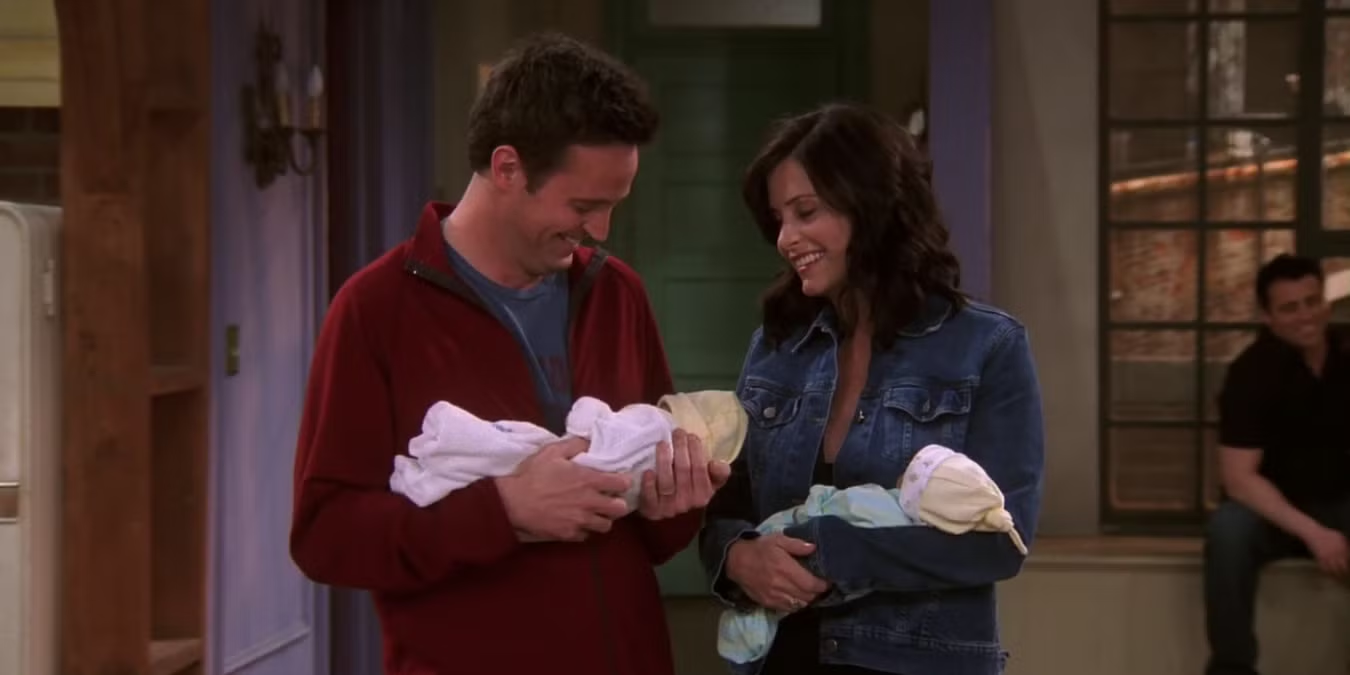
(Photo of Monica, Chandler and the twins, source: the TV Show “Friends” 2004, Screenrant.)
When it was time for parenting, I had settled in the UK, and I found the British adoption system confusing. As much as I was still ready to understand the steps and move forward, my partner at the time, the man I had chosen to have children with, had not committed 100% to the idea and he preferred to have a biological child. So, I had my first through pregnancy.
I still haven’t given up on my desire to grow my family through adoption, but I am significantly more realistic about what responsibility this would be for me and my other family, even for my friends and for my career.
“You need help to help her”
In the “Where Should We Begin?” podcast episode “You Need Help to Help Her“, November 24, 2025, a married couple seeks Esther Perel’s guidance after their young adult daughter experienced a serious breakdown. Two years prior, she withdrew from the world and her family completely.
The session explores how the parents’ high expectations, pressure to “fix” their child has shaped their daughter’s emotional distress. Esther gently reframes their concern as a reflection of how well-intentioned pressure can inadvertently contribute to a child’s suffering, urging them to understand the limits of their control and to rethink how support and connection are offered.
You’re probably thinking: “what does this have to do with anything?”
About three quarters into the episode, the mother mentions that their daughter was in fact adopted as a baby from China. She also mentions that they made a conscious decision to bring her and their biological son in a community with very little ethnic diversity, where she felt different her entire life.
What’s frustrating is that this was just an afterthought for these parents. They witnessed their child suffering through a breakdown for years and it didn’t even occur to them to consider that she may be feeling severed from her bloodline and culture. What’s even more surprising is that Esther Perel put no enfaces on this fact either. If I ever meet her, I would love to ask her “Why?”
Adoption: the blame game
Anther publication, closer to home, File on 4 Investigates: “Adoption: The Blame Game”, 28 November 2025, article and podcast episode under the same name, explores the scale of adoption breakdowns in the UK.
The documentary features adoptive parents Verity and Ian, pushed to crisis and Liam, 17, who they adopted when he was two. They expelled him from their home under a Section 20 arrangement after his physical aggression became unsafe for his parents. Liam expresses guilt about his own struggles, highlighting how trauma-shaped behaviour affects families. The programme critiques limited post-adoption support and systemic “blame” of parents.
It’s sad and maddening that after more than a decade in their care, the adoptive parents still considered the cause for their son’s behavioural problems to be his original trauma and insisted on help from the state, instead of taking full responsibility for this child, which since he was a toddler, was legally theirs to take care of.
And not only did they expel him from his home, while he was still a teen, but they left him with the guilt that it was all his fault.
They feel its unjust to be blamed for their unskilled parenting, but it’s somehow OK in their mind to leave their son with heavy guilt and banished from home.
“Returns and refunds” on adopted children
The same article continues to reveal an average of 5.7% of adopted children re-enter care, which is more than 1,000 over the past five years.
Another article from 2017 BBC News, ‘I sent my adopted son back into care‘ highlights parents describing behaviour by their 5-year old adopted son as domestic abuse.
Since when is it OK to use criminal wording on primary-aged children?
Children have been returned to care for so much as rejecting parents’ affections and attempts to love them.
The “state child” and the “low-needs” myth
Legally, adoption creates a permanent parent-child relationship.
So why does the law still allow adopted children to be returned to care? Why aren’t adoptive parents prosecuted for abandonment?
I sincerely hope it’s not because the state sees adoption as temporary or children as disposable. The state takes the child’s immediate protection as top priority.
So, adoption carries irrevocable moral responsibility, even if the law provides an exit. It does not come with the right to disengage when parenting becomes frightening, exhausting, or inconvenient.
The question should not be “why does the law allow children to return to care?”
The right question is “Why would anyone adopt without preparing to ensure they never do?”
“We’ll figure it out as we go” is the wrong approach
Or worse, “I’ll just ask my mum what I was like at that age” are not satisfactory starting points in parenting, especially through adoption. These are signals of unpreparedness.
In adoption, a trauma-free child is not a realistic expectation. Adoptees experience loss, instability, neglect, violence, prenatal stress or repeated separation. Even if those experiences are not visible as behaviour. Trauma is not something that can be screened out at matching; it usually emerges later, once a child feels safe enough to test whether that safety will hold.
So, parenting “on instinct” is a bad idea. Adopting a child is a conscious decision to take responsibility for harm you did not cause, but which you are agreeing to help repair.
If you’re serious about learning how to parent in ways that prioritise emotional safety, boundaries, and repair, not just obedience or good behaviour, I’ve collected a starting point here: The Gentle Parenting Reading List.
This isn’t “soft” parenting, and it isn’t adoption-specific. It’s about understanding children as humans with nervous systems, histories, and limits, which is the minimum requirement for parenting any child, adopted or not.
Given our Americanised perspective though, we may be tempted to think that if we had a system that allowed adoption from birth we could get a trauma-free child.
The British system vs the US “baby-market” model
The British adoption system is built on the principle that adoption exists to protect children, not to meet adult demand. Children are adopted after reunification and kinship options have been ruled out. Adoption is publicly funded, tightly assessed, and framed as a last resort, because the state recognises that adoption begins with loss and carries lifelong consequences for the child.
By contrast, the dominant model in the United States treats adoption, particularly infant adoption, as a private, consumer-driven process. Prospective parents are clients, money flows through the system, and expectant mothers are often positioned as suppliers of children. Choice, speed, and matching preferences are central. This creates a fundamentally different set of incentives: availability is prioritised, closed adoptions are encouraged, and the child’s long-term identity and trauma are secondary to adult satisfaction.
And if we’re still tempted to picture a Geller-Bing utopia, spending a little time on adoption support forums reveals the truth about the impact of such a system.
In these forums, a recurring pattern emerges. Adult need and urgency dominate decision-making. The long-term consequences for children and birth families are ignored.
Birth mothers in moments of acute crisis like domestic violence, post-partum psychosis, isolation are encouraged to make irreversible decisions within hours or days. Aspiring adopters contact vulnerable parents with offers of money, legal help, or “temporary” arrangements. The frame it as rescue, despite clear power imbalances.
Promises of openness and ongoing contact are withdrawn once the adoption is finalised.
Adoptees are reported left to grow up with conditional love by controlling parents, environment where they can never seem to fill the void their adoptive parents need filled. Statements like “buying children” and “I never chose to be born” are common in those forums. Many children are described as being raised gaslit, with no family history under closed adoptions.
Some adoptees later describe reunions that re-expose them to unresolved addiction, violence, and intergenerational trauma, left by their adoptive parents to manage boundaries alone.
Taken together, these accounts show a system, where the adult desire for a child, secrecy, or certainty routinely outweighs careful consideration of identity, continuity, informed consent, and the child’s lifelong psychological wellbeing.
The UK model accepts scarcity and difficulty as sign that the system works for the benefit of the children. The US model promotes abundance of supply and ease for the customers, i.e. the prospective parents.
The Nordic and French approaches: minimising adoption itself
Nordic countries and France go even further than the UK in questioning when adoption should happen at all. Across much of Scandinavia, adoption is rare. The prevailing value is that severing legal ties between children and their birth families is an extreme intervention, justified only in exceptional circumstances. Instead, these systems prioritise family support, long-term foster care, and maintaining identity and biological connections wherever possible. The aim is stability without erasure.
France shares this philosophy. Domestic adoption is tightly restricted, and relatively few children are legally freed for adoption. Many children in care remain wards of the state while retaining legal links to their parents. France has historically accepted long waiting times and low adoption numbers rather than creating mechanisms to increase “supply”.
Unlike market-oriented systems, neither the Nordic nor French models attempt to satisfy adult demand for children. They start from a different ethical premise: it is better for adoption to be rare, slow, and frustrating for adults than to risk repeating the harms of unnecessary separation for children.
Special parenting
Many adoptive parents talk as if adopted children require a special kind of parenting.
In reality, adoption simply removes the illusion that ordinary parenting can be inattentive, controlling, or emotionally lazy without consequences.
A child’s trauma does not create unreasonable demands. It reveals whether the adults are capable of offering safety, regulation, and repair without making the child responsible for the adult’s comfort.
If your love depends on gratitude, progress, or good behaviour, it isn’t unconditional and a child who has already been abandoned will find that out very quickly.
Regardless of how you have children, expect to need support, self-reflection, and professional help at points in your child’s life. Adoption does not create that need; it simply makes refusal to engage with it far more damaging.
Therapy is not compensation for having adopted the “wrong” child. It is part of the responsibility of raising a human being whose nervous system has been shaped by loss.
A final word of encouragement
This final word is also for myself, for whenever my life situation allows me to adopt my second child.
It is not that hard if you prepare and work on your emotional maturity a little. Never expect a child to have to fill some kind of void in you. You could get a dog for that.
Adults have the power, adults are responsible for therapy costs, time off work, not the state, not the child.
But the chance to bring a sad child’s smile back? That is worth all the sacrifices of parenting.

